

留言
留言
如果您对我们的产品感兴趣并想了解更多详情,请在此留言,我们会尽快回复您。
博客

博客

What Are the Key Differences Between a Backhoe Loader and a Skid Steer?

Aug 23, 2026

Have you ever wondered what the real difference is between a backhoe loader, sometimes referred to as a backhoe machine, and a skid steer equipped with a backhoe attachment? Both machines can handle loading and digging, so why choose one over the other?


The difference lies in their design, digging performance, maneuverability, and attachment versatility. This guide compares backhoe loaders and skid steer loaders based on their typical applications and operating conditions, providing a practical reference for equipment selection.


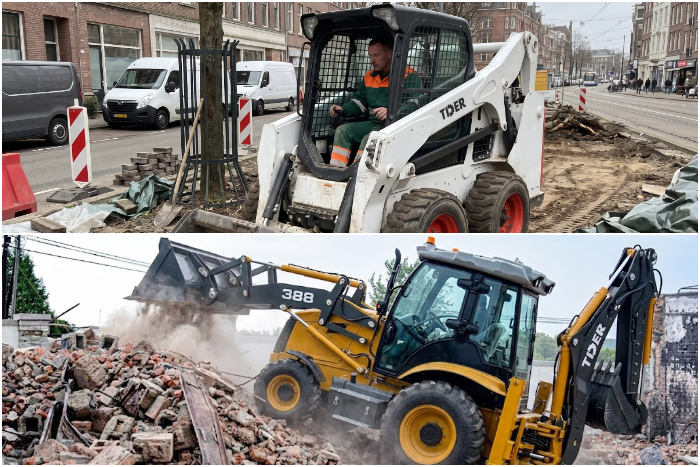
Backhoe Machine


1. Quick Answer: What Is the Main Difference?


The confusion is understandable because a skid steer can also be equipped with a backhoe attachment for digging. However, the two machines are fundamentally different in design and operating configuration.


A backhoe loader is purpose-built for both excavation and loading, with a dedicated rear digging arm. A skid steer is designed around compact maneuverability and attachment versatility, with digging capability depending on the attachment used.


In simple terms:

  • Deep excavation and trenching → Backhoe Loader
  • Compact work and versatile attachments → Skid Steer


The right choice depends on the depth of excavation, jobsite conditions, and the type of work you perform most often.


2. Backhoe Loader vs. Skid Steer: Key Differences


The fundamental difference lies in their design and operating configuration. A backhoe loader is built with both a front loading system and a dedicated rear digging unit, allowing it to switch between loading and excavation without changing the main working equipment.


A skid steer takes a different approach. Its compact chassis and quick attachment system allow one machine to perform many tasks by changing attachments. This makes it highly maneuverable and versatile, but its digging performance depends largely on the attachment being used.


Factor

Backhoe Loader

Skid Steer

Core design

Front loader + integrated rear excavator

Compact chassis + interchangeable attachments

Digging

Integrated digging system

Attachment-dependent

Maneuverability

Good

Excellent in confined spaces

Attachment flexibility

Good

Excellent

Typical strength

Excavation + loading

Compact, multi-purpose work


3. A Practical Comparison: TDER ZT15-20 vs. TDS65


To make this difference easier to understand, consider two TDER models: the ZT15-20 backhoe loader and the TDS65 wheel skid steer.


Key Specification ZT15-20 TDS65 With Attachments
Load Capacity 1,000 kg 950 kg
Front Bucket Capacity 0.6 m³ 0.5 m³
Digging Bucket Capacity 0.12 m³ 0.06 m³
Max. Digging Depth 2,350 mm With Backhoe Arm 2,000 mm
With Swing Backhoe Arm 2,000 mm
With Backhoe 2,400 mm
Engine Power 37 kW 55 kW
Hydraulic Flow 75 / 120 L/min
Overall Length 5,200 mm 3,580 mm with bucket
Max. Speed 25 km/h 12 km/h


What Do These Specifications Mean for Your Choice?


Similar loading capacity does not mean the machines are interchangeable. The ZT15-20 and TDS65 have relatively close loading capacities and bucket sizes, so both can handle general loading and material-handling work.


Their digging capabilities can also overlap. With the right Skid Steer Attachment, the TDS65 can reach a digging depth of up to 2,400 mm, compared with 2,350 mm for the ZT15-20.


The key difference is how these capabilities are delivered. The ZT15-20 integrates a dedicated rear excavating system, making excavation a core function of the machine. The TDS65 uses a compact skid steer platform and interchangeable attachments to adapt to different tasks.


Therefore, the better choice depends less on a single specification and more on your actual job requirements—such as excavation depth, available working space, frequency of attachment changes, and the type of work you perform most often.


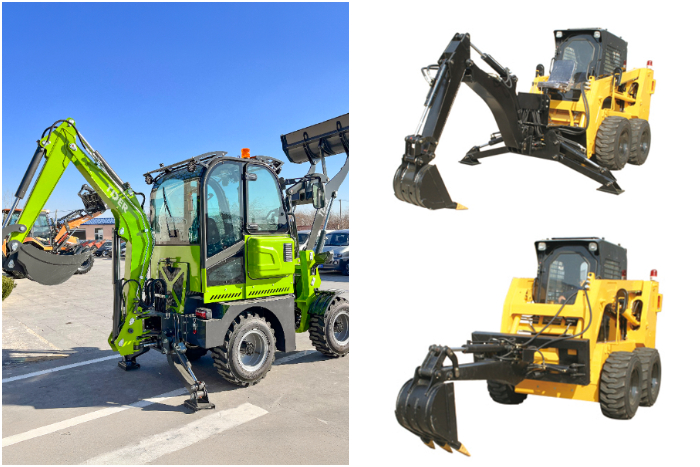
Skid Steer With Attachments


4. Which Machine Is Better for Your Project? How to Choose


The right choice depends on what you need the machine to do most often, rather than simply comparing specifications.


Choose a Backhoe Loader if:

  • Excavation is a core task — You regularly need to dig trenches, foundations, utility lines, or other deeper excavations.
  • You need both digging and loading — A dedicated rear excavator and front loader allow one machine to handle both operations without changing the main working configuration.
  • You want consistent digging performance — The backhoe system is integrated into the machine and ready for regular excavation work.
  • Your projects involve open jobsites — Road construction, utilities, infrastructure, and general construction are typical applications.


Choose a Skid Steer if:

  • Working space is limited — Its compact design and maneuverability are valuable on confined jobsites.
  • You use multiple attachments — A skid steer can switch between buckets, forks, sweepers, augers, backhoes, and other attachments for different tasks.
  • Versatility is more important than dedicated excavation — It is well suited to loading, grading, cleanup, material handling, and other multi-purpose work.
  • You need to adapt the machine to different jobs — The right attachment can expand its capabilities without requiring a different base machine.


A Simple Decision Rule:

  • Regular excavation + loading → Backhoe Loader
  • Compact work + multiple attachments → Skid Steer


Ultimately, the best machine is the one that matches your main workload, jobsite conditions, excavation requirements, and attachment needs.


5. Conclusion


Choosing between a backhoe loader and a skid steer ultimately depends on whether you need dedicated excavation and loading or compact operation with attachment flexibility. The TDER ZT15-20, for example, combines a front loader with an integrated rear excavator, while the TDS65 can expand its capabilities through different attachments.


For customers looking for a backhoe loader, TDER offers a range of commonly used models for construction, utilities, roadwork, and other applications. For customers who prefer the flexibility of Skid Steer Loaders, TDER can also provide different digging configurations:


Backhoe Arm — a simple, lightweight fixed digging arm for basic excavation.

Swing Backhoe Arm — similar in size and function, but with approximately 110° swing capability for greater working flexibility.

Backhoe attachment — a more complete digging system with an independent seat and stabilizing legs, providing greater digging depth and working range, but with higher attachment weight.


This means you do not always have to choose between a backhoe loader and a skid steer as completely separate solutions. The right TDER configuration can be matched to your excavation depth, working space, attachment requirements, and overall project needs.


6. FAQs

Can a skid steer be equipped with a backhoe attachment?

Yes. A skid steer can be equipped with different digging attachments, including a Backhoe Arm, Swing Backhoe Arm, and full Backhoe attachment. The right option depends on the required digging depth, working range, and jobsite conditions.

What is the difference between a Backhoe Arm and a Swing Backhoe Arm?

A Backhoe Arm is a simple fixed digging attachment for basic excavation. A Swing Backhoe Arm adds approximately 110° of swing, providing greater flexibility when digging alongside obstacles or in confined areas.

Which skid steer attachment is best for deeper excavation?

A full Backhoe attachment is generally the better choice when greater digging depth and working range are required. It includes an independent seat and stabilizing legs for more dedicated excavation work.

Can a skid steer with a backhoe attachment replace a backhoe loader?

Not always. A skid steer with a backhoe attachment can handle many digging tasks, but a backhoe loader is purpose-built for integrated excavation and loading. The better choice depends on how frequently you need to dig, the working space, and how often you need to change attachments.

Which is better for confined jobsites: a backhoe loader or a skid steer?

A skid steer is generally better suited to confined spaces because of its compact design and high maneuverability. A backhoe loader may be preferable when excavation and loading are both major requirements.


最新博客

索取报价

留言

留言
如果您对我们的产品感兴趣并想了解更多详情,请在此留言,我们会尽快回复您。
Start a Conversation

Hi! Click one of our members below to chat on